The trouble with film adaptations of books, especially films that are adapted from books as popular as David Nicholls's One Day, is that they attract to the cinema hoards of people who don't go to the cinema very often and who are not well versed in cinema etiquette. I can probably let off the groups of teenagers in the afternoon screening of One Day at my local Odeon for chatting and general pantomimish booing, hissing and cheering (hey, it's the end of the summer holidays...) but the couple next to me, who were probably in their late 30s, were far more annoying. After every single funny line (and there were plenty), they would roar with laughter, then repeat the line themselves, and laugh again.
Audience aside, I rather liked One Day, although I wasn't sure that I would. I read the novel one afternoon last Christmas, which is fast, even for me. I hadn't heard of the book before but Papa told me I had to read it. Clichéd as it may be to say so, I think I liked it because the heroine Emma "spoke" to me in some way. Haven't we all fallen for some hot and charismatic but generally crap bloke at some point (even if we weren't all wearing bad '90s specs and Doc Martens at the time and even if we weren't all northern)?
In the case of One Day, the girl in question is Emma (played by Anne Hathway in the movie) a clever and wry but unconfident would-be writer. On the night of her university graduation, way back in 1988--15 July, or St Swithun's Day, more specifcally--she hooks up with a handsome chancer named Dexter (Jim Sturgess). For various reasons, they end up just being friends and the movie, like the book, then checks in on them every year on St Swithun's Day.
For the first few years, Emma isn't in a good place. She works in a crappy Mexican restaurant in London, not spending enough time (or any time) working on her novel and later dates Ian (Rafe Spall), her co-worker and would-be comedian; Spall makes Ian particularly cringe-worthy in the film. Dex, meanwhile, goes off to India to find himself and then to Paris for yet another extended gap year, before walking into a job in TV production. He then becomes the presenter of some kind of TFI Friday-meets-Eurotrash TV show, sleeping around, doing coke and generally doing what was done in the '90s. Emma has, by this point, become a teacher and a pretty good one, and she has also ditched Ian and made some headway with her writing career. But she's still drawn to Dexter, even when he only calls when he wants something and then treats her badly when she does agree to meet him. When he sees Emma wearing one of those dark blue, silk, Chinese print dresses that everyone had in about 2000, at a friend's wedding, he thinks he may have made a mistake but it's too late because he's already impregnated the humourless and stiff-upper-lipped but rich and pretty Sylvie (Romola Garai) and they're getting married the following month.
But will there ever be a time and a place for Emma and Dex (to paraphrase the Pet Shop Boys in their 1997 cover of Somewhere, a '90s song that, unlike many others, was not featured in this film)? Well, yes, of course, because otherwise, it would probably be a bit of a let-down, but, perhaps fortunately, there weren't any promises of happy endings either.
Anne Hathaway's accent was far from pitch perfect ("no mate, I was going for Italian. Miss it?") but that was OK because otherwise I thought she did a good job of playing Emma and, without wishing to spoil the film too much, there was a moment where my eyes did tear up (in part because, thanks to the book, I knew what was coming). Jim Sturgess, meanwhile, whom I've seen previously in Fifty Dead Men Walking and 21 (does he only choose roles in movies with numbers in their title?) and in both of these films, he plays nice, well-meaning characters. Good guys. Dexter isn't really a good guy and he isn't even that well-meaning; at least not for most of the film. Sturgess certainly managed to make Dexter seem pretty unlikable at times, although I was somewhat distracted by the fact that he looked a lot like a guy from my year at St Jocks' (in the earlier scenes with the early-'90s, long, haircut; not so much in the 2000s, where the character's grey hair didn't look very convincing--I'm sure they had Just for Men then). His voice sounded a lot like Matt Berry's character in The IT Crowd, and confusingly, Matt Berry showed up for a brief cameo in One Day as Dexter's agent.
I enjoyed the music too and many of the other "period" details. Rachel Portman's score was good, although I like most of her film scores, such as Never Let Me Go and The Cider House Rules, and most of the other featured songs read like a compilation of "stuff I used to listen to in the '90s": Fatboy Slim's Praise You, Aftermath by Tricky, Rhythm of the Night by Corona, Roll to Me by Del Amitri, and the inevitable karaoke version of Robbie Williams's Angels, sung, in this case, by a bride at her wedding, with the rest of the guests joining in, drunkenly and out-of-tune, on the chorus. It's nice to find a film where nostalgia that is relevant to me (even if I was still at school in the '90s) plays an important role.
One Day is flawed, for sure, and many people who have read the book will, no doubt, be more critical of it than I, but I liked it. Equally, those who haven't read the book may find it a little too telegraphic, which is an almost inevitable by-product of turning a 400-page novel into a 107-minute film (one of the reviews of the movie I read called it a "greatest hits" of the book); it worked for me, but I could imagine some finding it a little shallow.

28 August 2011

24 August 2011
A Drinking Problem
One of the best things about running in Manhattan is that you are never far from a (working) drinking fountain. I hate carrying a bottle of water with me when I run and it's really handy to be able to stop briefly to rehydrate one or two times mid-session. London doesn't do so well; at least not in the parks in which I usually run: Regent's Park and Hyde Park. This helpful website does map most of the fountains in the city and lets you know if they are broken but doesn't usually account for problems like, "we're holding a music festival and the fountain isn't accessible unless you have a ticket," which happens pretty often in Hyde Park.
Still, Hyde Park does at least have the beautiful, shiny, spherical fountain designed by David Harber, which has multiple spouts and options for filling a bottle as well as drinking directly from the fountain. Even better, it's almost always working, even in winter, which means that it doesn't matter so much when the other two drinking fountains in Hyde Park are broken and/or unavailable.
Regent's Park is another story. There's this fountain, near the boating lake, but that's been out of action for months now. Then there's the very grand Sir Cowasjee Jehangir Fountain, which is over 140 years old. It's very impressive but somewhat unpredictable in terms of when it will dispense water and when it won't. It's reasonable enough to turn off the fountains in the winter months but this one also seemed to be off for long periods during the summer, much to my annoyance. With no obvious levers or buttons, I tried various combinations of standing on the blocks at its base, hitting the spouts and chanting, "open sesame!" Nothing worked. I knew there must have been a good reason to read Harry Potter!
On Monday, though, as I jogged up to the fountain, I noticed that one of the spouts appeared to be working but by the time I arrived, it had stopped. I had water with me so it wasn't such a big deal but today we wanted to investigate further. And indeed, when I held my hand under the spout today, magically, the water appeared. It turns out that there is a tiny, near-invisible motion sensor tucked just inside each spout; once activated, the flow is on a timer. The sensors must be new as on previous occasions when the fountain was working, we'd never seen the water stop flowing. But finally, the mystery is solved.
Of course, once the weather starts getting nippy again, the powers that be will probably turn off the water supply. Until then, I plan to take advantage of the fountain as much as I can.
 |
| Photo by Ambernectar 13 |
Regent's Park is another story. There's this fountain, near the boating lake, but that's been out of action for months now. Then there's the very grand Sir Cowasjee Jehangir Fountain, which is over 140 years old. It's very impressive but somewhat unpredictable in terms of when it will dispense water and when it won't. It's reasonable enough to turn off the fountains in the winter months but this one also seemed to be off for long periods during the summer, much to my annoyance. With no obvious levers or buttons, I tried various combinations of standing on the blocks at its base, hitting the spouts and chanting, "open sesame!" Nothing worked. I knew there must have been a good reason to read Harry Potter!
 |
| Photo by stephengg |
Of course, once the weather starts getting nippy again, the powers that be will probably turn off the water supply. Until then, I plan to take advantage of the fountain as much as I can.
19 August 2011
Nowheresville Nostalgia
After four years at the University of Cantab, I wanted to stay in Cambridge partly because R was going to be there doing his master's and partly because I wasn't ready for London yet and the only other place I could imagine living was Oxford, which was where I grew up. Two years later, as more of my friends gravitated London-ward, I finally took the plunge and left Cambridge behind.
I don't miss the crap shopping, the lack of independent espresso bars, the fact that not much happens, the killer bikes, the killer tourists or the crap transportation (see photo). But this evening, I went back to catch up with some old friends, and I remembered that there are some things I do miss about Nowheresville (these are all from the "town" rather than "gown" perspective):
 |
| I'm glad I wasn't planning to get the 21:45 then... |
I don't miss the crap shopping, the lack of independent espresso bars, the fact that not much happens, the killer bikes, the killer tourists or the crap transportation (see photo). But this evening, I went back to catch up with some old friends, and I remembered that there are some things I do miss about Nowheresville (these are all from the "town" rather than "gown" perspective):
- Spending a sunny Friday evening at one of the riverside pubs, sipping a G and T and watching the punt chaos on the Cam.
- The Arts Picturehouse -- a lovely independent cinema -- and reasonably priced cinema tickets.
- The prettiness of most parts of the city centre compared to London.
- Overhearing the random chatter of overconfident, over-intelligent and over-loud people (mainly students).
- Bumping into people you know: I was only in town for a few hours and I saw someone from my office and some guys from St Jocks'.
- After three years in London, the Nowheresville air felt incredibly clean.
- The almost eerie peacefulness: in the gown-dominated parts of town, like Pembroke Street, even on a summer Friday night, you can roam the streets and meet only a handful of quiet, civilised folks.
I wouldn't move back, of course, but I do feel grateful that I still have reasons to visit (one reason fewer once PhDE moves Down Under at the end of the month).
 |
| Tidying up the Mill Pond punts |
18 August 2011
W00t Puts Down Roots
Almost four years after w00t was named Word of the Year by Merriam Webster, it has finally been granted a place in the next edition of the OED. As the full list of new words hasn't been revealed on the OED's website, I have only second-hand sources like this article in the Telegraph to go on, and naturally the Torygraph was keen to highlight other trendy words, like jeggings (but not Jedward), retweet and sexting.
Interestingly, over the past four years, w00t's spelling has become more conventional; the news outlets reporting this story are all spelling it as woot, and a Google search pulls up 57.7 million hits for woot and only 17 million for w00t (most of the latter on Slashdot and 4chan). Technically, woot already appears in the OED, although it doesn't get its own entry. In the entry for wit (meaning "to know," as in "to wit"), there's a nice quotation from The Canterbury Tales featuring the word: "For aught I woot he was of Dertemouthe" (for all I know, he came from Dartmouth). It also appears as a variant form of "you will" in Middle English. "Woo't weepe, woo't fight...woo't teare thy selfe?" (will you cry? Will you fight? Will you cut yourself?). OK, so woot 2.0 isn't exactly taking the place of a word that is likely to be retweeted any time soon...
As for w00t, I still use it occasionally, although much less than I used to. And I definitely still use Bridezilla, 3G and backstabbing, all of which were added to the OED last year (the latter seemed to arrive several decades late), but I've still never heard anyone use a-life, bum rap or panga...
Edit: I've now found a post by the editor, Angus Stevenson, on the OUP blog about this. I do subscribe to this blog but I must have missed this post. Perhaps he should have put textspeak (which was, I thought spelled txtspk; see this post) or one of the other newly accepted words, into the title.
Interestingly, over the past four years, w00t's spelling has become more conventional; the news outlets reporting this story are all spelling it as woot, and a Google search pulls up 57.7 million hits for woot and only 17 million for w00t (most of the latter on Slashdot and 4chan). Technically, woot already appears in the OED, although it doesn't get its own entry. In the entry for wit (meaning "to know," as in "to wit"), there's a nice quotation from The Canterbury Tales featuring the word: "For aught I woot he was of Dertemouthe" (for all I know, he came from Dartmouth). It also appears as a variant form of "you will" in Middle English. "Woo't weepe, woo't fight...woo't teare thy selfe?" (will you cry? Will you fight? Will you cut yourself?). OK, so woot 2.0 isn't exactly taking the place of a word that is likely to be retweeted any time soon...
As for w00t, I still use it occasionally, although much less than I used to. And I definitely still use Bridezilla, 3G and backstabbing, all of which were added to the OED last year (the latter seemed to arrive several decades late), but I've still never heard anyone use a-life, bum rap or panga...
Edit: I've now found a post by the editor, Angus Stevenson, on the OUP blog about this. I do subscribe to this blog but I must have missed this post. Perhaps he should have put textspeak (which was, I thought spelled txtspk; see this post) or one of the other newly accepted words, into the title.
14 August 2011
Et Tu, Caesar?
Another week, another ape-related movie. Of course, the release dates of Rise of the Planet of the Apes (ROTPOTA) and Project Nim were nicely coordinated in the UK, and it's not difficult to see the similarities--arrogant man takes baby chimp, raises him as human and is then suitably shocked when cute baby chimp becomes seriously aggressive adult chimp--but only ROTPOTA is fictional. Some spoilers may follow, although let's face it: it is over 40 years since the original Planet of the Apes.
The arrogant human in ROTPOTA is Will Rodman (James Franco), a scientist working on a promising new Alzheimer's drug, ALZ112, at a pharmaceutical company in San Francisco. His father (John Lithgow) has Alzheimer's and this clouds Will's judgement enough for him to think that n=1 is good science. Based on the fact that one chimp (named Bright Eyes because of the way the ALZ112 made her eyes turn a bright, clear green) has shown a remarkable recovery after being treated with the drug, Will persuades his boss Steven Jacobs (David Oyelowo) to go ahead with the flashy press conference and start pitching to investors. Unfortunately, part way through the pitch, Bright Eyes goes wild, breaking free of her cage and smashing through the glass into the meeting room, baring her teeth at all and sundry and knocking down anyone who tries to stop her. It later emerges that her aggression was probably due to the fact that she thought her newborn baby was being threatened, rather than because of ALZ112, but it's too late--the trials are halted and all the apes are put down.
One of the lab technicians finds Bright Eyes' baby and persuades Will to take him home for a few days until a space at a primate reserve opens up. A few days later and Will has fallen in love and ends up keeping the chimp, whom he names Caesar. It turns out that effects ALZ112 had on Bright Eyes have been passed on to Caesar (it's unclear whether this is through the bloodstream or because of epigenetic changes; I'm trying to avoid passing judgement on the science in this movie) and he becomes super intelligent. For eight years or so, he and Will have a great time, signing to each other (Caesar also seems to understand when Will talks), visiting Muir Woods and chatting up cute vets like Caroline (Freida Pinto).
Meanwhile, based on the progress Will has observed in Caesar, he starts treating his dad with ALZ112 and wow, Pops makes a startling recovery. But wait, because this really isn't a good movie week for big pharma: Will's father's immune system starts to fight back against the "ALZ112 virus and Will decides they need to use a stronger form of the drug. Jacobs is impressed (although not wild about yet another n=1 trial) and agrees to start trials of a stronger form of the drug, ALZ113, on chimps. Even though one of the lab technicians breathes in some of the gas containing the ALZ113 and gets very sick very quickly.
Caesar, now eight or so, is getting too big to keep in the house and after he bites the finger off an aggressive neighbour who was attacking Will's dad, Caesar is taken away to a primate centre. Will and Caroline only see a large enclosure with lots of toys and rocks and not the cage into which Caesar is later shut. Initially bullied by the other ape inmates, the charismatic Caesar gets them on side by bribing them with cookies and then later with his presumably rousing sign-language speeches. And because this is a film and not reality, he "learns" to speak (even though chimps don't have the right vocal anatomy to speak). He can say, "no" and "war" and, later, "Caesar is home." And so it is here that the eponymous rise of the planet of the apes begins.
Franco and the other human leads were fine but as with Project Nim, this movie aroused almost no sympathy in me for the humans and plenty for the apes, particularly Caesar, who goes on to shun, although not kill, Will (in fact, he prefers to leave the killing to the other apes), in favour of his new ape buddies, whom he leads into battle against the people of San Francisco. SF was a good city to choose given that the Golden Gate Bridge, on which the grand finale takes place, is a dramatic setting and is also often shrouded in mist, giving the apes a crucial advantage. ROTPOTA had a compelling storyline, nice character development (of the apes, at least), and it managed to be fun, while still having some more moving scenes. I just don't think I can watch any more films with mistreated animals for the time being, even if the animals in question are CGI!
The arrogant human in ROTPOTA is Will Rodman (James Franco), a scientist working on a promising new Alzheimer's drug, ALZ112, at a pharmaceutical company in San Francisco. His father (John Lithgow) has Alzheimer's and this clouds Will's judgement enough for him to think that n=1 is good science. Based on the fact that one chimp (named Bright Eyes because of the way the ALZ112 made her eyes turn a bright, clear green) has shown a remarkable recovery after being treated with the drug, Will persuades his boss Steven Jacobs (David Oyelowo) to go ahead with the flashy press conference and start pitching to investors. Unfortunately, part way through the pitch, Bright Eyes goes wild, breaking free of her cage and smashing through the glass into the meeting room, baring her teeth at all and sundry and knocking down anyone who tries to stop her. It later emerges that her aggression was probably due to the fact that she thought her newborn baby was being threatened, rather than because of ALZ112, but it's too late--the trials are halted and all the apes are put down.
One of the lab technicians finds Bright Eyes' baby and persuades Will to take him home for a few days until a space at a primate reserve opens up. A few days later and Will has fallen in love and ends up keeping the chimp, whom he names Caesar. It turns out that effects ALZ112 had on Bright Eyes have been passed on to Caesar (it's unclear whether this is through the bloodstream or because of epigenetic changes; I'm trying to avoid passing judgement on the science in this movie) and he becomes super intelligent. For eight years or so, he and Will have a great time, signing to each other (Caesar also seems to understand when Will talks), visiting Muir Woods and chatting up cute vets like Caroline (Freida Pinto).
 |
| My photo of the Golden Gate Bridge in the mist |
Meanwhile, based on the progress Will has observed in Caesar, he starts treating his dad with ALZ112 and wow, Pops makes a startling recovery. But wait, because this really isn't a good movie week for big pharma: Will's father's immune system starts to fight back against the "ALZ112 virus and Will decides they need to use a stronger form of the drug. Jacobs is impressed (although not wild about yet another n=1 trial) and agrees to start trials of a stronger form of the drug, ALZ113, on chimps. Even though one of the lab technicians breathes in some of the gas containing the ALZ113 and gets very sick very quickly.
Caesar, now eight or so, is getting too big to keep in the house and after he bites the finger off an aggressive neighbour who was attacking Will's dad, Caesar is taken away to a primate centre. Will and Caroline only see a large enclosure with lots of toys and rocks and not the cage into which Caesar is later shut. Initially bullied by the other ape inmates, the charismatic Caesar gets them on side by bribing them with cookies and then later with his presumably rousing sign-language speeches. And because this is a film and not reality, he "learns" to speak (even though chimps don't have the right vocal anatomy to speak). He can say, "no" and "war" and, later, "Caesar is home." And so it is here that the eponymous rise of the planet of the apes begins.
Franco and the other human leads were fine but as with Project Nim, this movie aroused almost no sympathy in me for the humans and plenty for the apes, particularly Caesar, who goes on to shun, although not kill, Will (in fact, he prefers to leave the killing to the other apes), in favour of his new ape buddies, whom he leads into battle against the people of San Francisco. SF was a good city to choose given that the Golden Gate Bridge, on which the grand finale takes place, is a dramatic setting and is also often shrouded in mist, giving the apes a crucial advantage. ROTPOTA had a compelling storyline, nice character development (of the apes, at least), and it managed to be fun, while still having some more moving scenes. I just don't think I can watch any more films with mistreated animals for the time being, even if the animals in question are CGI!
12 August 2011
And Da Polpo Makes Four
I've been a fan of Russell Norman's London restaurants since I first visited Polpo at the beginning of last year, soon after it opened. I didn't realise that Polpo was going to be the first of a small collection but as Time Out put it, "When the chain is Polpo, however, this is no bad thing. We all need a little New York hip now and again, a cool soundtrack and the illusion of Big-Apple edginess." There are now four in the club but although they all serve varying degrees of Italian- and New York-inspired dishes and varying levels of small plates vs traditional main courses, they have quite different vibes.
Polpo (which means octopus) is on Beak Street, in the heart of Soho, and it's always busy after 6.30, not helped by the no-reservations policy in the evening. If you're lucky you can grab a space at the zinc bar and drink a glass of Prosecco while you wait. The restaurant is dark, noisy and bustling but it's a great ambiance and the food is very tasty. Then came Polpetto (mini octopus), still in Soho but further south, tucked away above the French House, a Dean Street pub. The menu is similar to Polpo but the vibe is a little more chilled out; then again, it was still early when we were dining there and I can imagine that on a Thursday or Friday night, the queues soon grow.
Polpo III is called Spuntino (snack, although they could really call it Polpettino (tiny octopus) and is probably the coolest kid in the family. When I went, soon after it opened, at 6.15 on a Wednesday, the queue was out of the door of the tiny restaurant, which barely has seats for 20 people, mostly around the bar. The menu--and the vibe--is a lot more Lower East Side Manhattan than the first two Polpi, with "sliders" and mac and cheese adorning the menu. Spuntino is very cool but not exactly a place to linger over a relaxing dinner. There's no phone, no reservations and barely even any indication outside that you've reached the right place (other than the queue).
And so finally we come to Da Polpo (chez Polpo), which could really be called Polpone (big Polpo), as it's like a bigger, more spacious, airier version of the original. The Covent Garden location on Maiden Lane seems, oddly, to be much quieter than the others. At 6.30 on a Friday night, BB and I didn't need to wait for a table for two and even when we left, there didn't appear to be a queue, although the downstairs section seemed pretty busy. As with the other Polpi, there is plenty of zinc, plenty of exposed light bulbs and pew-like benches. The menu is more similar to Polpo than to Spuntino, although as with the latter, there is a heavy focus on meatballs; in Da Polpo, however, the meatballs are served in sauce and with spaghettini, Italian-style, rather than as a pseudo-burger. BB and I both opted for the meatball-spaghettini combo, which tasted good and wasn't bad value at £7. We also shared some of the ciccheti (bite-sized portions, like arancini and, my favourite, potato and parmesan croquettes) and a Nutella pizzetta for pudding.
With a glass of Prosecco each, this came to £36, including service, which felt like a lot for not huge amounts of food (enough food to fill me up, of course) but it does all taste very good and the lovely Maiden Lane restaurant is such a nice place to hang out on a Friday night and if you're in Covent Garden and want to eat at a cool restaurant that has tasty, interesting Italian food and is about the opposite of a tourist trap, you could definitely do much worse than Da Polpo. The original is still my favourite restaurant, though.
I didn't take my camera so I have no good pictures but the gallery on the Da Polpo website captures the feel of the place pretty well.
Da Polpo. 6 Maiden Lane, London, WC2E 7NA (Tube: Covent Garden). Website.
Polpo (which means octopus) is on Beak Street, in the heart of Soho, and it's always busy after 6.30, not helped by the no-reservations policy in the evening. If you're lucky you can grab a space at the zinc bar and drink a glass of Prosecco while you wait. The restaurant is dark, noisy and bustling but it's a great ambiance and the food is very tasty. Then came Polpetto (mini octopus), still in Soho but further south, tucked away above the French House, a Dean Street pub. The menu is similar to Polpo but the vibe is a little more chilled out; then again, it was still early when we were dining there and I can imagine that on a Thursday or Friday night, the queues soon grow.
Polpo III is called Spuntino (snack, although they could really call it Polpettino (tiny octopus) and is probably the coolest kid in the family. When I went, soon after it opened, at 6.15 on a Wednesday, the queue was out of the door of the tiny restaurant, which barely has seats for 20 people, mostly around the bar. The menu--and the vibe--is a lot more Lower East Side Manhattan than the first two Polpi, with "sliders" and mac and cheese adorning the menu. Spuntino is very cool but not exactly a place to linger over a relaxing dinner. There's no phone, no reservations and barely even any indication outside that you've reached the right place (other than the queue).
With a glass of Prosecco each, this came to £36, including service, which felt like a lot for not huge amounts of food (enough food to fill me up, of course) but it does all taste very good and the lovely Maiden Lane restaurant is such a nice place to hang out on a Friday night and if you're in Covent Garden and want to eat at a cool restaurant that has tasty, interesting Italian food and is about the opposite of a tourist trap, you could definitely do much worse than Da Polpo. The original is still my favourite restaurant, though.
I didn't take my camera so I have no good pictures but the gallery on the Da Polpo website captures the feel of the place pretty well.
Da Polpo. 6 Maiden Lane, London, WC2E 7NA (Tube: Covent Garden). Website.
11 August 2011
Happy Is the Country Which Has No History
The first two things I learned about the film Sarah's Key were 1) it stars Kristin Scott Thomas and 2) it is based on the book of the same name by Tatiana de Rosnay, so I knew it wasn't going to be the most cheerful of films, even before I knew what it was about (when was the last time KST laughed in a film, anyway? I've seen about eight of her movies from the last eight years and I don't remember her laughing in any of them).
I recently read a copy of another de Rosnay book, A Secret Kept, which tells the story of a grown-up brother and sister who return to the village in Brittany where they went on holiday as children and on the drive back to Paris, the sister is about to tell the brother something terrible when she passes out and crashes the car. While the sister remains in a coma, her brother reflects on the past and begins to investigate the death of their mysterious mother when they were teenagers. I enjoyed this novel a lot, although it was certainly very dark.
Sarah's Key (originally: Elle s'appelait Sarah) is also very dark and very sad, and has a similar structure, in some ways, to A Secret Kept. KST plays Julia, an American journalist who has lived in France for 25 years, who is investigating the Vel' d'Hiv Roundup, the nickname for the two nights in July 1942 when, on orders from the Nazis, the French police rounded up over 13,000 Jews and transported them to the Vélodrome d'Hiver, before their subsequent deportation to concentration camps in Germany and Poland. The story of Julia getting the story is intertwined with the story of the eponymous Sarah, and her family. They were taken off to Vel' d'Hiv but not before Sarah managed to hide her young brother in a cupboard in their apartment and lock the door. She promised she would be back, but then she--and none of the others, in fact--really knew just how dire a situation they were in. Meanwhile, Julia's architect/work-obsessed husband Bertrand has just arranged the renovation of his grandparents' apartment in the Marais in Paris. Funnily enough, his grandmother lived their for 60 years (and it's 2002, by the way)...
It's hard to say much more about the plot without spoiling things but suffice to say, it did bring a tear to my eye at various moments. As usual, I didn't empathise a huge amount with KST's character (there is something about her that makes me feel as though she is patronising or lecturing me personally rather than her inevitable crappy-husband character), and I kept wanting the focus to remain on Sarah and her family rather than Julia's present-day woes, although I concede that structurally, the film worked well.
I have, of course, seen Schindler's List and Primo Levi's Se questo è un uomo (If this is a man) was one of my Italian set texts in the "Visions of Hell" literature paper I took at university, not that either lessens the impact of watching a film that depicts such a horrific period of European history. I learned a lot of quotations from Se questo è un uomo for my exam; oddly, most of the ones that I can still remember feature mainly German words: an Auschwitz guard describing the prisoners' eating using the verb fressen (usually used for animals) rather than essen, and, most notably, "Hier ist kein Warum." There's no "why" here. How could there be?
I recently read a copy of another de Rosnay book, A Secret Kept, which tells the story of a grown-up brother and sister who return to the village in Brittany where they went on holiday as children and on the drive back to Paris, the sister is about to tell the brother something terrible when she passes out and crashes the car. While the sister remains in a coma, her brother reflects on the past and begins to investigate the death of their mysterious mother when they were teenagers. I enjoyed this novel a lot, although it was certainly very dark.
Sarah's Key (originally: Elle s'appelait Sarah) is also very dark and very sad, and has a similar structure, in some ways, to A Secret Kept. KST plays Julia, an American journalist who has lived in France for 25 years, who is investigating the Vel' d'Hiv Roundup, the nickname for the two nights in July 1942 when, on orders from the Nazis, the French police rounded up over 13,000 Jews and transported them to the Vélodrome d'Hiver, before their subsequent deportation to concentration camps in Germany and Poland. The story of Julia getting the story is intertwined with the story of the eponymous Sarah, and her family. They were taken off to Vel' d'Hiv but not before Sarah managed to hide her young brother in a cupboard in their apartment and lock the door. She promised she would be back, but then she--and none of the others, in fact--really knew just how dire a situation they were in. Meanwhile, Julia's architect/work-obsessed husband Bertrand has just arranged the renovation of his grandparents' apartment in the Marais in Paris. Funnily enough, his grandmother lived their for 60 years (and it's 2002, by the way)...
It's hard to say much more about the plot without spoiling things but suffice to say, it did bring a tear to my eye at various moments. As usual, I didn't empathise a huge amount with KST's character (there is something about her that makes me feel as though she is patronising or lecturing me personally rather than her inevitable crappy-husband character), and I kept wanting the focus to remain on Sarah and her family rather than Julia's present-day woes, although I concede that structurally, the film worked well.
I have, of course, seen Schindler's List and Primo Levi's Se questo è un uomo (If this is a man) was one of my Italian set texts in the "Visions of Hell" literature paper I took at university, not that either lessens the impact of watching a film that depicts such a horrific period of European history. I learned a lot of quotations from Se questo è un uomo for my exam; oddly, most of the ones that I can still remember feature mainly German words: an Auschwitz guard describing the prisoners' eating using the verb fressen (usually used for animals) rather than essen, and, most notably, "Hier ist kein Warum." There's no "why" here. How could there be?
07 August 2011
The Chimp's Tale
I first came across Project Nim during my the year of my degree. As background reading for my intro to linguistics courses, I had, of course, picked up a copy of Steven Pinker's The Language Instinct, which includes a section on how human language differs from animal communication systems. Later, when I had transferred to the linguistics Tripos, I learned more about Nim in my language evolution and language acquisition lectures. At the time, I was more interested in Alex the parrot but Nim's story is actually more compelling--and sadder--than the linguists had me believe.
In the 1970s, it seemed, a group of linguists and psychologists tried to raise a baby chimpanzee (nicknamed Nim Chimpsky; tee hee) as a human and, more specifically, to teach him American Sign Language. Initially hailed as a success, with Nim apparently learning dozens or even hundreds of signs, the project picked up a lot of media coverage but ultimately the principal investigator, Herbert Terrace, admitted that scientifically, the project was a failure. Nim hadn't learned as many signs as originally thought and many of the signs weren't ASL signs, resembling instead those made by chimps in the wild. More importantly, the signs that Nim did produce weren't combined systematically in anything even vaguely resembling the structure or grammar seen in human languages. He might sign something along the lines of, "Nim eat Nim eat," or "Banana me me me eat," whereas even a two-year-old human child uses a far more sophisticated language. Meanwhile, as Nim grew older, he grew smarter and learned how to manipulate his human trainers into giving him exactly what he wanted, so the claim that he knew and understood a language in the same way humans do, is flawed.
So, I knew that Project Nim had failed scientifically but I didn't know just how badly the people working on the project failed Nim. This is where Project Nim, a documentary directed by James "Man on Wire" Marsh, comes in, and Marsh tells a fascinating, strange and often sad tale, starting with Nim's traumatic separation from his mother at ten days old, before being brought to the Upper West Side apartment of Stephanie LaFarge, a grad student in psychology, who had three children and four step-children. She was a former student--and former lover--of Herbert Terrace and her role was to treat Nim as she would a human baby and to teach him sign language. She even breast-fed him (as her then 12-year-old daughter says, wryly looking back on that time, "It was the '70s...").
But as one of Nim's newly recruited teachers, an undergraduate research assistant, Laura Ann Pettito, who was later to become another one of Terrace's student-lovers, put it, "[the LaFarge apartment] was chaos." In fact, so was the whole project at that point: no systematic note-making, no journals, no schedule, no plan. This was why Pettito and several other teachers were brought in: to try to bring some method to the madness and eventually, Terrace took Nim away from LaFarge and installed him, along with Pettito and the rest of the rolling cycle of teachers, in a giant country mansion owned by Columbia University. LaFarge had always resented Pettito's increasing role as Nim's surrogate mother and so was devastated when Nim was taken away, although, as Pettito points out quite smugly, Nim didn't seem that fussed to leave LaFarge.
The rest of Nim's story is rather sad. Once he'd reached the age of five, he was strong and aggressive, had very sharp fangs and had a habit of biting people really hard. To the distress of the teachers who had come to love Nim, Terrace announced that the project was over and they all flew Nim back to the Oklahoma primate centre where he was born. The spoiled, only-child chimp, used to wearing clothes, sleeping in beds and living with people was forced to get used to a sparse, cramped cage, but he did at least make one friend--a cheerful young hippy named Bob.
All was well until the primate centre went bust and the animals had to be sold to an animal research lab. Nim underwent various experiments but thanks to a lawyer who was able to drum up plenty of media interest, he was eventually released and bought by a Texas animal sanctuary. As the only chimp, however, Nim wasn't happy there. He smashed several TVs and killed a barking poodle by tossing it against a wall. Bob wasn't allowed to visit either. Eventually, though, the ranch was taken over, Bob was allowed to visit and the owner was encouraged to buy several chimp friends to keep Nim company. But he died from a heart attack at the age of 26 (chimps tend to live to about 40 in the wild, but can live to be 60 in captivity).
Despite his habit of mauling people who wrong him, Nim comes off very well from Marsh's movie, which is more than can be said for most of the humans. In their present-day voice-overs, those involved in Nim's life are very quick to criticise and denigrate others. Terrace, in particular, comes across as arrogant and sleazy, while LaFarge and Pettito snipe and attempt to one-up each other on camera. It's easy with hindsight to say how little thought went into how raising a chimpanzee as a human might affect the chimp, especially if it came to the point where he had to return to live with other chimps, but this seems to be true. Nim certainly never forgave LaFarge for "abandoning" him: when she came to visit him at the ranch, at least ten years after she last saw him, he appeared to recognise her although wasn't very happy to see her. She went into his cage and he attacked, dragging her around by the ankle before eventually letting her go. He didn't want to kill her, it was thought, but he did want to show her who was boss.
These days animal ethics committees exist to regulate experiments involving animals, although unlike the Declaration of Helsinki for research involving human subjects, there is no worldwide body to do the equivalent for animal research. Efforts to determine similarities between human language and animal communication systems continue, meanwhile: Klaus Zuberbühler's group have detected some sort of very rudimentary syntax in gibbons and Campbell's monkeys, for example.
The real reason we are so interested in animal languages, of course, is that we still don't really understand how our own ability to talk and verbally communicate with one another evolved, the underlying basis for language, or how children acquire language. I tend to fall in with the Michael Tomasello camp, whereby humans' ability to acquire a language comes from general enhanced cognitive ability, with pattern finding and analogy skills being particularly important. But that's a blog post for another time...
In the 1970s, it seemed, a group of linguists and psychologists tried to raise a baby chimpanzee (nicknamed Nim Chimpsky; tee hee) as a human and, more specifically, to teach him American Sign Language. Initially hailed as a success, with Nim apparently learning dozens or even hundreds of signs, the project picked up a lot of media coverage but ultimately the principal investigator, Herbert Terrace, admitted that scientifically, the project was a failure. Nim hadn't learned as many signs as originally thought and many of the signs weren't ASL signs, resembling instead those made by chimps in the wild. More importantly, the signs that Nim did produce weren't combined systematically in anything even vaguely resembling the structure or grammar seen in human languages. He might sign something along the lines of, "Nim eat Nim eat," or "Banana me me me eat," whereas even a two-year-old human child uses a far more sophisticated language. Meanwhile, as Nim grew older, he grew smarter and learned how to manipulate his human trainers into giving him exactly what he wanted, so the claim that he knew and understood a language in the same way humans do, is flawed.
So, I knew that Project Nim had failed scientifically but I didn't know just how badly the people working on the project failed Nim. This is where Project Nim, a documentary directed by James "Man on Wire" Marsh, comes in, and Marsh tells a fascinating, strange and often sad tale, starting with Nim's traumatic separation from his mother at ten days old, before being brought to the Upper West Side apartment of Stephanie LaFarge, a grad student in psychology, who had three children and four step-children. She was a former student--and former lover--of Herbert Terrace and her role was to treat Nim as she would a human baby and to teach him sign language. She even breast-fed him (as her then 12-year-old daughter says, wryly looking back on that time, "It was the '70s...").
 |
| Nim and one of his teachers; photo by Susan Kuklin |
The rest of Nim's story is rather sad. Once he'd reached the age of five, he was strong and aggressive, had very sharp fangs and had a habit of biting people really hard. To the distress of the teachers who had come to love Nim, Terrace announced that the project was over and they all flew Nim back to the Oklahoma primate centre where he was born. The spoiled, only-child chimp, used to wearing clothes, sleeping in beds and living with people was forced to get used to a sparse, cramped cage, but he did at least make one friend--a cheerful young hippy named Bob.
All was well until the primate centre went bust and the animals had to be sold to an animal research lab. Nim underwent various experiments but thanks to a lawyer who was able to drum up plenty of media interest, he was eventually released and bought by a Texas animal sanctuary. As the only chimp, however, Nim wasn't happy there. He smashed several TVs and killed a barking poodle by tossing it against a wall. Bob wasn't allowed to visit either. Eventually, though, the ranch was taken over, Bob was allowed to visit and the owner was encouraged to buy several chimp friends to keep Nim company. But he died from a heart attack at the age of 26 (chimps tend to live to about 40 in the wild, but can live to be 60 in captivity).
Despite his habit of mauling people who wrong him, Nim comes off very well from Marsh's movie, which is more than can be said for most of the humans. In their present-day voice-overs, those involved in Nim's life are very quick to criticise and denigrate others. Terrace, in particular, comes across as arrogant and sleazy, while LaFarge and Pettito snipe and attempt to one-up each other on camera. It's easy with hindsight to say how little thought went into how raising a chimpanzee as a human might affect the chimp, especially if it came to the point where he had to return to live with other chimps, but this seems to be true. Nim certainly never forgave LaFarge for "abandoning" him: when she came to visit him at the ranch, at least ten years after she last saw him, he appeared to recognise her although wasn't very happy to see her. She went into his cage and he attacked, dragging her around by the ankle before eventually letting her go. He didn't want to kill her, it was thought, but he did want to show her who was boss.
These days animal ethics committees exist to regulate experiments involving animals, although unlike the Declaration of Helsinki for research involving human subjects, there is no worldwide body to do the equivalent for animal research. Efforts to determine similarities between human language and animal communication systems continue, meanwhile: Klaus Zuberbühler's group have detected some sort of very rudimentary syntax in gibbons and Campbell's monkeys, for example.
The real reason we are so interested in animal languages, of course, is that we still don't really understand how our own ability to talk and verbally communicate with one another evolved, the underlying basis for language, or how children acquire language. I tend to fall in with the Michael Tomasello camp, whereby humans' ability to acquire a language comes from general enhanced cognitive ability, with pattern finding and analogy skills being particularly important. But that's a blog post for another time...
02 August 2011
Under the Skin
The Spanish trailer for the new Pedro Almodóvar film, The Skin I Live In (shurely: The Skin in Which I Live) has been played at every film I've seen at Curzon cinemas for the past month or so, and it's really freaky. The only other Almodóvar film I've watched is Broken Embraces, which is also weird but haunting and engagingly complex.
The Skin I Live In mainly just seems pretty twisted and yet strangely compelling with Antonio Banderas playing a very smooth, suave and un-Zorro-like plastic surgeon with a troubled past. Or, as IMDb puts it, "A brilliant plastic surgeon, haunted by past tragedies, [who] creates a type of synthetic skin that withstands any kind of damage. His guinea pig: a mysterious and volatile woman who holds the key to his obsession."
I'm not sure which bits of the trailer freak me out the most: maybe the tongue, the masks/bandages and even the crash-test-dummy-like costumes worn by some of the characters. A rough translation is available on this IndieWire post. I quite like the soundtrack but it seems at odds with the rest of the trailer, which in part feels a bit like a James Bond movie from the 1970s, mashed up with some sort of sci-fi film. Weirdest of all, it doesn't star Penélope Cruz. I guess she was busy filming PoTC4; good call, Pen. Not.
NB: To see the embedded video, you might need to click through to my blog if reading this in Google Reader.
The Skin I Live In mainly just seems pretty twisted and yet strangely compelling with Antonio Banderas playing a very smooth, suave and un-Zorro-like plastic surgeon with a troubled past. Or, as IMDb puts it, "A brilliant plastic surgeon, haunted by past tragedies, [who] creates a type of synthetic skin that withstands any kind of damage. His guinea pig: a mysterious and volatile woman who holds the key to his obsession."
I'm not sure which bits of the trailer freak me out the most: maybe the tongue, the masks/bandages and even the crash-test-dummy-like costumes worn by some of the characters. A rough translation is available on this IndieWire post. I quite like the soundtrack but it seems at odds with the rest of the trailer, which in part feels a bit like a James Bond movie from the 1970s, mashed up with some sort of sci-fi film. Weirdest of all, it doesn't star Penélope Cruz. I guess she was busy filming PoTC4; good call, Pen. Not.
NB: To see the embedded video, you might need to click through to my blog if reading this in Google Reader.
01 August 2011
Filling a Hole in the Wall
For a while now, I've been wanting to add some more decoration to one of the remaining blank walls of my bedroom, but I've always procrastinated this decision because there always seemed to be too many options from which to choose.
1. Something to do with movies. There is already the poster from the 62nd Festival de Cannes in my living room (which features L'avventura) but I think that still allows for another movie-related piece in my bedroom. I could choose the poster from one of my all-time favourite films, such as The Last Picture Show or Vertigo, but I don't love either of the designs. Or, I could go for the poster for Never Let Me Go, a film which I liked a great deal, which still haunts me now and whose poster I also like (not just because it has Andrew Garfield on it).
2. Something to do with NYC. I have a series of three framed photos on my bedroom wall, which show, I hope, unconventional shots of the Big Apple. One has a view of the Manhattan skyline taken through a chainlink fence on a building site in Brooklyn; another of an Expedia billboard on Broadway from 2006, which reads, "Be nice to tourists. You might be one yourself soon." I love this set of three prints, one of New York, one of London and one of Paris. But although to buy all three and frame them might take up too much space, I don't think they are as cool individually as they are as a set.
3. Something to do with caffeine. Coffee represents the third part of the triumvirate that is Bex (movies, Manhattan, macchiato; maybe that should be the title of my next blog). I like this design by Sandra Juto, although as I don't use a Moka pot to make my coffee, perhaps it isn't moi enough.
4. Something to do with typography. My inner geek does adore a nice bit of typography, so these posters from Spineless Classics really appeal. They print the entire text of a novel (very, very small) on a poster, working around a design that is relevant to the book. Unfortunately, none of the books they have at the moment are quite right for me (and I can't possibly request a Sweet Valley High print!). Finally, combining my love of typography with my love of maps, these maps from Axis are amazing. The streets, parks, water features and every other part of the maps' design are made from type (i.e. the street/park name). These are awesome but at $60 including shipping (plus the cost of a frame), they are quite expensive. That doesn't mean I won't get one...
You can see, anyway, that I have a lot of really nice options from which to choose, which inevitably means I just end up choosing none, so any advice is very welcome!
1. Something to do with movies. There is already the poster from the 62nd Festival de Cannes in my living room (which features L'avventura) but I think that still allows for another movie-related piece in my bedroom. I could choose the poster from one of my all-time favourite films, such as The Last Picture Show or Vertigo, but I don't love either of the designs. Or, I could go for the poster for Never Let Me Go, a film which I liked a great deal, which still haunts me now and whose poster I also like (not just because it has Andrew Garfield on it).

 |
| Via MoviePoster.com |
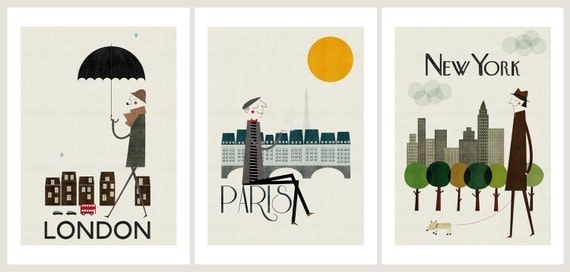
2. Something to do with NYC. I have a series of three framed photos on my bedroom wall, which show, I hope, unconventional shots of the Big Apple. One has a view of the Manhattan skyline taken through a chainlink fence on a building site in Brooklyn; another of an Expedia billboard on Broadway from 2006, which reads, "Be nice to tourists. You might be one yourself soon." I love this set of three prints, one of New York, one of London and one of Paris. But although to buy all three and frame them might take up too much space, I don't think they are as cool individually as they are as a set.
 |
| Via Blancucha, Etsy |
3. Something to do with caffeine. Coffee represents the third part of the triumvirate that is Bex (movies, Manhattan, macchiato; maybe that should be the title of my next blog). I like this design by Sandra Juto, although as I don't use a Moka pot to make my coffee, perhaps it isn't moi enough.
4. Something to do with typography. My inner geek does adore a nice bit of typography, so these posters from Spineless Classics really appeal. They print the entire text of a novel (very, very small) on a poster, working around a design that is relevant to the book. Unfortunately, none of the books they have at the moment are quite right for me (and I can't possibly request a Sweet Valley High print!). Finally, combining my love of typography with my love of maps, these maps from Axis are amazing. The streets, parks, water features and every other part of the maps' design are made from type (i.e. the street/park name). These are awesome but at $60 including shipping (plus the cost of a frame), they are quite expensive. That doesn't mean I won't get one...
 |
| Via Axis Maps. |
You can see, anyway, that I have a lot of really nice options from which to choose, which inevitably means I just end up choosing none, so any advice is very welcome!